How to Preserve the Family Stories Behind Old Photos
- 04 Sep, 2026

How to Preserve the Family Stories Behind Old Photos
An old photograph can bring a room, a person, or an entire season of life back in an instant. You may recognize the porch before you remember the address, or remember the sound of a relative’s laugh before you can place everyone standing beside them.
But a photograph is only the beginning of the story. Years from now, someone looking at it may not know who took it, what happened just before the shutter clicked, or why that ordinary afternoon mattered. The most valuable work is not only saving the image. It is saving what the image means.
You do not need to identify every photograph in an archive before you begin. Choose one picture, follow the questions it raises, and capture the memory while it is close enough to reach.
Start with the photograph that makes you pause
A useful photograph is not necessarily the oldest, clearest, or most valuable one. Start with the picture that creates a feeling or brings a detail to mind.
It might be:
- A family gathering where one person is looking away from the camera
- A child standing outside a first home
- A group photograph from school, work, or military service
- A holiday table with a familiar dish in the center
- A blurred snapshot from a trip no one has described in writing
- A portrait of someone whose voice you can still hear
Set aside the pressure to build a complete archive. Your first goal is to discover one story worth preserving. Once you have recorded one, the next photograph may become easier to approach.
Record what you can see before interpreting it
Look at the photograph slowly and describe the visible details without trying to explain them yet. This gives you a firm starting point and may awaken memories you did not expect.
Notice:
- The people and where they are standing or sitting
- Clothing, hairstyles, objects, and decorations
- The room, street, landscape, or building in the background
- The weather, season, or quality of light
- Anything unusual, unfinished, or slightly out of place
- What is missing from the frame
Instead of writing “This was a happy family day,” begin with something more specific: “My father is holding the paper bag near the kitchen door, and my sister is wearing the yellow cardigan she disliked.” Specific observations give the story somewhere to go.
Do not worry if you cannot name every person. Write down what you know, then mark the uncertainty. “I think this is our neighbor’s daughter” is more useful than silently filling in a name you may later forget is only a guess.
Ask what happened before and after the picture
Photographs freeze one second, but memories usually live in the minutes around it. Ask yourself what the camera did not capture.
Before the photograph
- Why were you there?
- Who suggested taking the picture?
- What had everyone been doing?
- Was anyone expected but absent?
- What conversation or event had just happened?
After the photograph
- Where did everyone go?
- What happened later that day?
- Did the picture mark a beginning, ending, or ordinary pause?
- What did you understand about the moment then?
- What do you understand differently now?
A photograph of people outside a house may become a story about moving day, a first visit, a difficult goodbye, or simply the afternoon a cousin brought a new camera. You cannot see that context in the image, but it may be the part your family most wants to remember.
Use the five senses to bring the scene back
Visual details are only one doorway into a memory. Once you have described what is in the frame, try to remember what the scene sounded, smelled, felt, or tasted like.
Consider:
- What could you hear: traffic, music, a radio, children, or silence?
- What did the room or outdoor air smell like?
- What were you holding or standing on?
- Was the day hot, cold, windy, or damp?
- What food or drink was nearby?
- What texture or small physical detail do you still remember?
You do not need to add sensory details to make the story more dramatic. Use them because they are clues. The smell of floor polish may lead to a school memory. The sound of a screen door may bring back a whole summer. A particular plate may reveal who usually cooked and who always arrived late.
Separate what you remember from what you can confirm
Family memories change as they are retold. Two people may remember the same gathering differently, and a photograph may confirm one detail while leaving several others uncertain.
As you write, make a simple distinction between:
- What the photograph shows: details visible in the image
- What you remember: your personal experience of the moment
- What someone told you later: another person’s account
- What you are unsure about: names, dates, or sequence that need checking
This does not make a story less meaningful. It makes it more honest. You can write, “I believe this was the summer before we moved,” or “My brother remembers the trip happening in August.” Clear uncertainty is better than an exact detail that no one can trust later.
If another family member remembers the scene, invite them to add their perspective rather than asking them to confirm every sentence. Their version may reveal a detail you missed or show why the moment mattered to them in a different way.
Ask open questions when a photograph belongs to someone else
When you find a photograph of a parent, grandparent, aunt, or friend, avoid questions that can be answered with one word. “Who is this?” may identify a person, but it rarely opens the story.
Try questions such as:
- What do you remember about the place in this photograph?
- What was happening just outside the frame?
- Who was the person you spent the most time with that day?
- What did you look forward to at that age?
- What would surprise me about this picture?
- What did this home, job, school, or neighborhood mean to you?
- Is there a story connected to something someone is holding?
- What do you wish you could tell the people in this photograph now?
Leave room for the answer to wander. A question about a coat may lead to a first job. A question about a kitchen may lead to a family recipe or a story about the person who taught you to cook. Those connections are not distractions; they are often the real history.
Capture the story in the way that feels natural
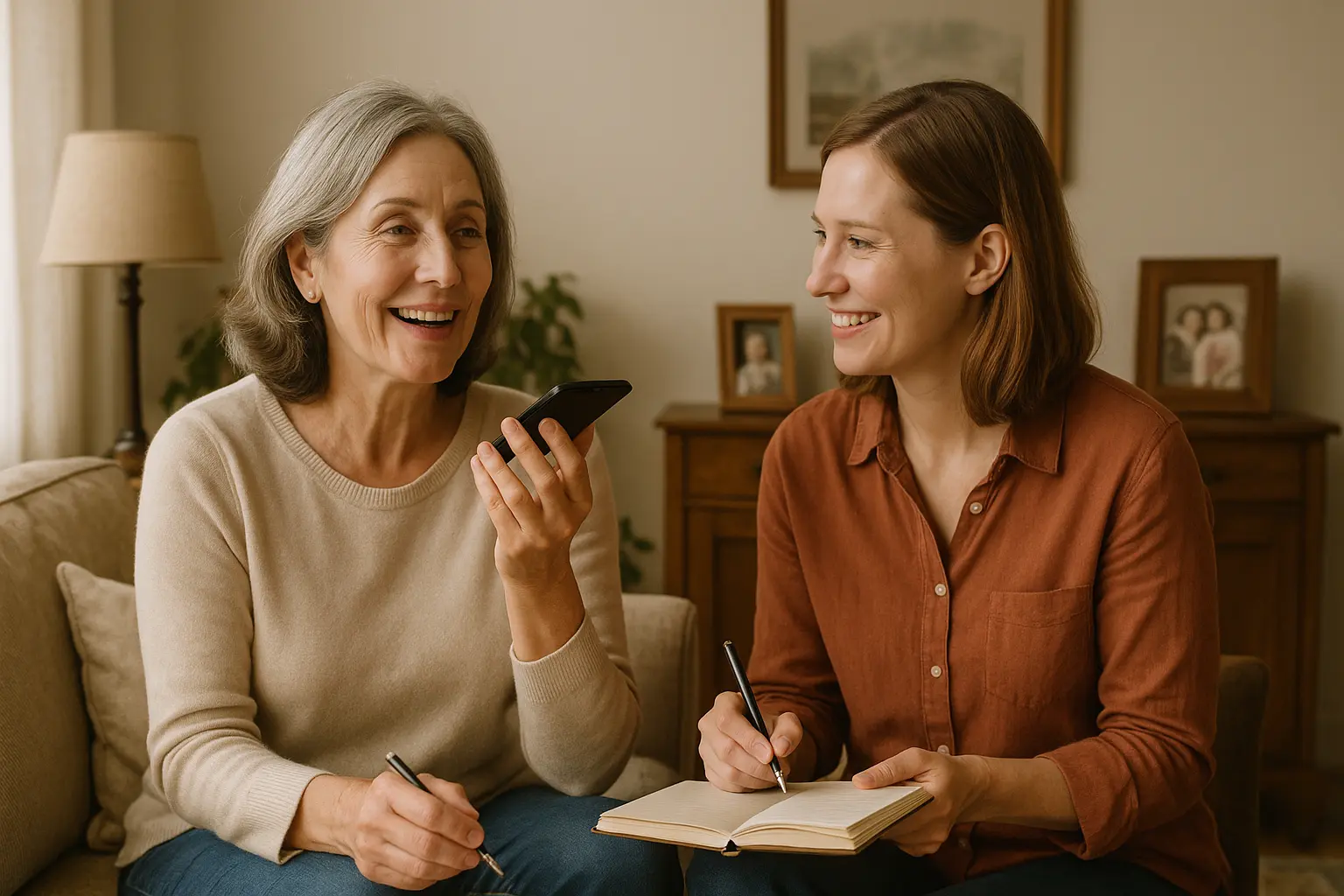
Some people find it easier to write while looking at a photograph. Others remember more when they speak freely and describe what they see out loud. There is no requirement that the first version be polished.
If you write, begin with a sentence such as:
“Whenever I see this photograph, I remember…”
If you speak, describe the picture as though you were showing it to a relative who has never seen it. Say the names you know, explain what is uncertain, and follow the first detail that brings a memory forward.
Life Memoirs lets you answer thoughtful memoir questions with a written response or a voice recording. A spoken answer can then be transcribed, reviewed, and edited before you develop it into your story. That makes it possible to focus on remembering first instead of trying to produce finished prose immediately.
Give each photograph a useful title
A filename such as IMG_2048 will not help your family understand why a picture matters. Give the story a title that offers a doorway into the memory.
Compare:
- “Summer 1987”
- “The Afternoon We Waited for the Blue Bus”
Or:
- “Grandmother in the Kitchen”
- “The Apron She Wore Whenever Someone Needed Feeding”
A good title does not need to be poetic. It needs to distinguish this memory from the others and point toward the detail or feeling at its center. You can always change it after the story is written.
Add context for the person who was not there
The people who inherit your photographs may not recognize the places or relationships that seem obvious to you. Add the context you would want a stranger in the family to have.
Explain:
- How each person is related to you
- Where the photograph was taken
- Approximately when it happened
- Why everyone had gathered
- What the place looked like before it changed
- Which details are no longer visible today
Imagine a grandchild finding the photograph many years from now. What would they need to know to feel present in the scene? A short explanation of the house, neighborhood, or family relationship can matter as much as the event itself.
Let ordinary photographs stay ordinary
Not every photograph needs a dramatic event behind it. A picture of someone washing dishes, waiting at a station, or sitting in a familiar chair may preserve the texture of daily life better than a formal celebration.
Ask what the ordinary moment reveals:
- What did a normal morning look like?
- Who usually handled this task?
- What objects were part of everyday life?
- What routine has disappeared?
- What did you take for granted then?
A memoir becomes more complete when it includes the repeated details of life, not only its milestones. Family history lives in ordinary gestures: the way someone set a table, repaired a bicycle, greeted a neighbor, or made space for one more person.
Keep the story connected to your wider memoir
One photograph may belong to several parts of your life. A picture from a school performance could connect to education, family support, confidence, or the first person who encouraged your creativity. Do not force it into only one interpretation on the first attempt.
Capture the story where it naturally appears, then notice its connections later. A memoir page about one photograph can lead to another question, another person, or a related memory from a different decade. Over time, those links can help you see a larger pattern in your life.
Life Memoirs organizes memories into topics and helps turn individual answers into memoir pages that you can review and arrange. You can begin with one photograph and decide on the larger structure after more stories exist.
A simple old-photo storytelling worksheet
Use these prompts for one photograph at a time:
What can I see?
- Detail:
- Detail:
- Detail:
Who is here, and what is my relationship to them?
What happened just before the photograph?
What happened afterward?
What can I hear, smell, taste, or feel in the scene?
What do I know, and what am I unsure about?
Why has this photograph stayed with me?
What would I want a future family member to understand?
A few honest paragraphs are enough for a first story. You can return later to add names, context, or another person’s perspective.
Preserve the memory, not only the picture
Old photographs are powerful because they give memory a visible starting point. But the meaning behind the image is what allows future readers to meet the people, places, and everyday life it contains.
Choose one photograph that makes you pause. Describe what you see, follow the questions around it, and capture the story in your own voice. Then do the same with another picture when you are ready.
Life Memoirs helps you turn spoken or written answers into an organized life story you can review and shape over time. Start preserving your family stories with Life Memoirs when you are ready to give the memories behind your photographs a place to live.
Your family may already have the pictures. The story is what only you can add.